I can’t count the times an aspiring writer complained to me, “But I read a script by So-and-So Famous Writer and they did that! And now you’re telling me I can’t?”
Yes, they did break so-called sacrosanct screenwriting rules. But you can’t break conventions until you have mastered them.
These conversations inspired my last three ScriptMag columns on Breaking The Rules, particularly the dictatorial “Show, Not Tell.” Each explores a different type of masterfully breaking the rules, and offers examples from screenplays and teleplays by revered writers across genres and decades:
And, possibly my favorite,Breaking The Rules Part 3: Pro Secrets – The Deft Cheat, explores techniques to create memorable scenes, evoke mood, and reveal unspoken character dynamics in engaging, cinematic, magical moments.
These articles showcase how A-List writers, having mastered the fundamentals, skillfully bend, break, and reinvent the rules with intention and finesse. Once your storytelling reaches that level, you can, too.
Read, Read, and Read
Rather than feeling frustrated, see these scripts as opportunities to learn. The great writers who came before you left a roadmap – scripts that demonstrate what they did and how they did it.
Aspiring writers no longer have to visit a museum to study the masters. While you can make an appointment at the Writers Guild Foundation Shavelson-Webb Library, or travel to the AMPAS Margaret Herrick Library, now thousands of scripts – dating back to the early decades of film – are readily available for free online, with just a little bit of sleuthing.
Search for:
[TITLE] screenplay OR teleplay PDF download free
While some sites feel shady or host useless transcripts, award-nominated scripts are often officially released by the studios to promote them to the industry. Ignoring these resources is like trying to become a surgeon without studying anatomy or observing live surgeries.
Learning from the Masters
Throughout history, mastery required apprenticeship and often hardship. Michelangelo began apprenticing at 13. He studied the masters. He dissected cadavers to grasp the underlying musculature of the body before turning to sculpture. By 24 he had completed the Pietà. Michelangelo wanted to create a work he described as “the heart’s image.” His most famous sculpture, David, was completely when he was he was 29.
Studying and mastering the skills of the experts is your opportunity to dissect and examine what is beneath the surface of human emotion before you become a renowned sculptor.
As a writer, you don’t need to cut up bodies or clean paint brushes, but you should study the master writers to grasp how they reveal what lies beneath the surface.
Essential Reading: Career-Launching Spec Scripts
To inspire your reading list, I’ve selected some of my favorite scripts by first-time screenwriters, whose debuts led to box office success, critical acclaim and even Academy Awards® for nominations for Best Original Screenplay.
Before the 1990s, many nominees had extensive experience in theatre or television. But the 90s were a Golden Era for spec scripts as studios were still eager to buy them in the 80s, leading an abundance of unique, original works. Bygone days for the industry, I’m afraid.
12 Angry Men (1957) – Reginald Rose technically this won Best Adapted Screenplay, but it was based on Rose’s own original teleplay, so it’s my call to put him on this list
The Producers (1968) – Mel Brooks (Won) (What arena hadn’t Mel Brooks notched impressive achievements prior to this, with a career that started on the Borsht Belt just after WWII and flourished in television and theatre in the 1950s. Nevertheless, this was his first feature film, beating 2001: A Space Odyssey by Stanley Kubrick and Faces by John Cassavetes.)
Breaking Away (1979) – Steve Tesich (Won)
Moonstruck (1987) – John Patrick Shanley (Won) (note he had written and continues to write numerous successful plays)
Thelma & Louise (1991) – Callie Khouri (Won)
The Fisher King (1991) – Richard LaGravenese (Won)
The Sixth Sense (1999) – M. Night Shyamalan
American Beauty (1999) – Alan Ball (Won)
Being John Malkovich (1999) – Charlie Kaufman
Gosford Park (2001) – Julian Fellowes (won)
My Big Fat Greek Wedding (2002) – Nia Vardalos
Little Miss Sunshine (2006) – Michael Arndt (won)
Juno (2007) – Diablo Cody (Won)
The Big Sick (2017) – Emily V. Gordon & Kumail Nanjiani
Get Out (2017) – Jordan Peele (Won)
Promising Young Woman (2020) – Emerald Fennell (Won)
In The Beginning
What fascinates me most is each writer’s origin story: Each “in the beginning” is different. Some writers were ready to quit – just one more idea that they simply had to write. Others were just starting out. Some wrote a first draft in days, others went through hundreds of versions.
As a special treat, here are some enlightening interviews with the writers on how these specs came into being, their writing, and what they want to say with their stories:
While I urge you to consume a steady diet of good scripts, don’t shy away from the bad ones. Analyzing where and why they fall short will sharpen your skills and strengthen your storytelling techniques. Growing up, once in the theatre, I never walked out of a bad film; there was always something to learn.
Your best education is right at your fingertips! Start reading, studying, and dissecting.
Ernest Hemingway is credited with saying, “The only kind of writing is rewriting,” although countless writers have expressed a variation on “Writing is rewriting.” While this conventional wisdom is solid, in screenwriting, continually doing a traditional Page-One Rewrite yields diminishing returns.
While I’ve offered up seven essential pointers for the polish and hone phase of rewriting, these innovative techniques that can boost your next draft, creating an impeccable script and an exceptional reading experience – key to impressing readers and advancing your career.
Rewriting is always work, but it comes with rich rewards. Adopting this new system can make the labor easier and produce more impressive results.
Press Pause
Congratulations! You did make it to “Fade Out.” But before you jump into a rewrite, step away. A little time off can yield big benefits. Set a time limit of a day or two so you have a plan in place, setting boundaries in advance.
After staring at the screen, writing, reading, and reworking, a break is an opportunity to refresh. Get out – of your workspace. Do an activity you enjoy, utterly unconnected to writing. Choose something active that doesn’t involve a lot of thinking but has a tangible result. Whatever floats your boat: baking bread, hiking to a scenic spot, working in the garden, or working out.
My favorite benefit of pressing pause is the phenomenon of “Sudden Illumination” – that spark of creativity that happens when we stop hunting for answers and instead to allow for the creative magic of the solutions that pop up when we stop seeking them.
So step back and take a not only well-deserved break, but an essential opportunity to refresh, re-energize, and let your subconscious take the wheel.
Press Print
I remember thinking I would never be able to write creatively on a computer. Now I can’t imagine how I survived writing on paper, with arrows and asterisks drawn all over the page whenever I discovered a better way to say something. Cut and paste – yes, please!
But rewriting is different.
I never post a column or a blog without printing it out. An astonishing amount of little errors slip by when reading on the computer. The inevitable better ideas can be scribbled in, and a couple of good old arrows and asterisks can move text around, then back to the computer to implement it. I can’t explain it, but there is something powerful about having words on paper and a pen in your hand.
This is a crucial aspect of the Just One Thing Rewrite, so please print. Don’t bother with three-hole punch paper – you’re not gonna need it. And that also means no brads necessary. Now you’re ready to work.
Scene-by–Scene
Solid scenes stand alone, as if they are a small story unto themselves. The best way to check is by reading one scene at a time – but not in order, or you’ll become caught up in the through line. The strongest scenes do two things at once – advance the plot and develop character.
Ask Yourself: Are you giving characters time to digest new information or shift emotional states? Is there a build in the big moments? Are you getting into the scene as late as possible? Does the scene build and end on a strong note? Can you wrap it up with a “bow” or a “button” – a great line and/or a meaningful action or reaction? If the scene was cut, would the screenplay still work? If so, it’s not essential. Does the scene add something new to the story? If not, then revise it or cut it.
Be on the Look Out For: Scenes that are filler. Expository scenes, transition scenes, and flashbacks are all scenes to consider trimming, revising, incorporating into other scenes, or cutting.
Dialogue Only
Each character should have a distinctive voice. By the time readers are in Act Two, we shouldn’t have to read the slug to know who is speaking. Read it aloud to hear the flow. If it’s awkward coming from your mouth, even a terrific actor won’t make it work. Great dialogue has a flow, a build, and a rhythm. See my ode to Aaron Sorkin as part of my discussion of “The Rule of Threes” in dialogue, along with many other terrific examples here.
Be on the Look Out For: Characters whose voices don’t remain consistent. There might be a distinctive cadence to their dialogue. If they use slang or have an accent at the outset, then they shouldn’t suddenly switch from “ain’t” to “shan’t,” or from “y’all” to “youse.”
Description Only
I’ve devoted entire ScriptMag articles to description, but here’s what you should focus on in the description-only pass:
Are you giving us what is essential to know about the character when they are introduced? Is this something that can or will be conveyed cinematically?
Are you conveying the atmosphere of significant settings? Just enough to give us the flavor.
Is your detail too specific? Small details slow the pace. Unless they’re essential to conveying the atmosphere or establishing the character, we don’t need them. Leave the color of the shirt to the costume designer and the pile of the rug to the set designer.
Are you telling us what we see as we see it? A character doesn’t flinch before the punch is thrown. Using “as” is a dead giveaway here.
Do the sentences read smoothly? It should flow for the reader. Avoid lengthy sentences. Punctuate perfectly.
Ask Yourself: Are you using the same verb or adjective in close proximity? This signals weak writing and gives the piece a repetitive feel. Push yourself for variety, without going overboard.
Be on the Look Out For: More than three things in introducing a primary character or significant setting is giving us a grocery list, not a description. Avoid obsessing over small actions that our brains automatically fill in. Of course a character extends their arm to shake hands or turns the knob to exit through a door. Speaking of exiting, watch out for description that sounds like a play, such as having characters “enter” or “exit” a scene. It feels flat, not cinematic.
Backasswards
This may seem counterintuitive, but the backwards pass is a terrific tool because it pulls your focus to the look and the formatting. The last page is a terrific place to start. If it’s a half page long or less, now is the time to hunt down widows/orphans – lines with only one or two words – and rewrite the sentence so it is tighter. With strong word choices, you can say more with less and have greater impact for a better read. That’s the real goal. And, although less significant, you’ll also have a shorter page count.
Ask Yourself: Are there big blocks of dialogue or description? If so, what can be tightened and trimmed, or cut altogether. Is the page cluttered? As I said in “Five Things Readers Wish Every Writer Knew,” reading is literally hard on the eyes. We’re not asking you to make our job easier, just don’t make it more difficult. Keep it clean, clear and consistent. Scene numbers are for shooting scripts. If you have characters whose dialogue is in a language other than English, just above the first time it happens try this:
NOTE: Portuguese dialogue is in italics and will be subtitled.
I’m sure this will controversial, but I’m encouraging my consulting clients and the pro writers working on projects with me to eliminate unnecessary formatting, even if it means overriding the software. We really, truly do not need (CONT.), or (cont’d), (MORE) and CUT TO. Call the software company for help if you can’t figure out how. Keep parentheticals to a minimum and never use them in description – it’s either significant or it’s not. I also find characters exact ages in parentheticals to add annoying visual clutter. Unless significant to the plot, or in the case of kids from babies to teens, “thirties” will do fine and not limit casting. All CAPS for sound effects is outdated, but if you’ve got a particularly significant one, the BOOM of an explosion or the furious SLAM of a door that needs to land with impact, then have at it. Underlining or CAPPING for emphasis in dialogue adds clutter. It’s cleaner and every bit as impactful when italicized, just as it would be in a document. Honestly! Nevertheless, be judicious.
Be on the Look Out For: Inconsistent formatting. The spacing between lines and scenes can be thrown off in the best of programs. How you choose to convey the text of a sign or a jump in time should always look the same. No long slug lines. This is no place to convey the setting; that’s the job of description. Dashes and ellipses in dialogue are two different things. Dashes indicate a pause or hesitation, stuttering or sputtering, or being interrupted. Ellipses indicate trailing off, such as a character searching for what to say, and imply a longer pause. Lots of ellipses add a lot of clutter. Don’t be heavy-handed with either.
Just One More Thing
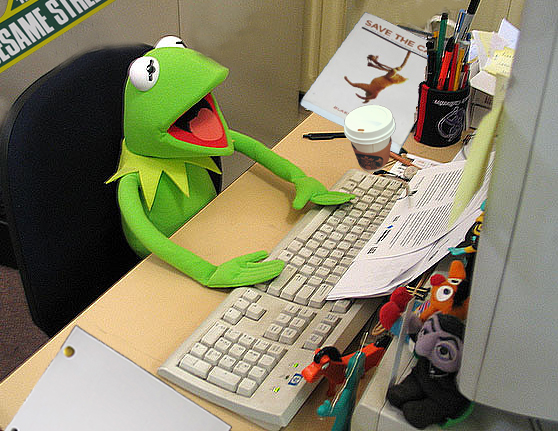
An experienced reader can – and will – pick up your script and be able tell in one to two minutes tops if you’re an accomplished writer or an aspiring amateur. One of my earliest ScriptMag articles, It’s Not Easy Being Green, shows you how to convince us you’re inexperienced, brought to you straight from Sesame Street!
Any of these rewriting techniques can elevate your writing, which is essential in impressing readers with your execution.
All of them are designed to trick your brain into seeing your words on the page with fresh eyes.
While a great consultant can catch these fumbles, practicing them with these rewriting strategies will train your brain to become aware of them as you write. Strengthening these muscles one at a time makes the heavy lifting easier with each script and every draft you do, as it becomes instinct instead of effort.
Theme is a strong tool that can power your writing. Identifying your Personal Thematic, is a concept I first learned from producer and screenwriter Meg LeFauve, and story consultant, Laurie Hutzler that can impact your entire writing process.
Themes add meaning and resonance to your story. That which moves you has the power to move others.
Writing a piece that speaks to your Personal Thematic is motivating and energizing. It gets you excited and keeps you going – even when the going gets tough – long into the tedium of rewrites. It brings focus to the story that enables you to make choices faster and more effectively. And it powers your work because it taps into core concepts and beliefs that you desperately want to express – to share with the world.
That is how important Personal Thematic is to elevating your writing.
Screenwriters Speak on Themes
Over the course of my career as a film industry exec, and as a producer, it has been a great privilege to work with truly talented writers. What I have learned has been invaluable.
I wanted to bring this kind of knowledge to the students in my online seminar, Screenwriting Elevated. So I started featuring a Surprise Guest Speaker each month. I choose a writer whose work they class has read as part of the monthly assigned scripts. I might show a clip or read a scene from their work. And, admittedly, I like the added reveal of the students not knowing who the speaker will be!
Some are easy asks for me. Some are my Screenwriting Fangrrl idols, and just “the ask” made my heart pound a bit. All are incredibly articulate and very generous with their time, eager to answer any and all questions.
After the introduction, I ask just one question to get the ball rolling:
What themes – a character type, a dilemma, or a conflict, an idea – do you find yourself drawn to, again and again, in your work?
Of course, this goes straight for what fascinates me the most about the creative process.
I love hearing their answers! And I think you will too.
This show I’m working on right now that is my first foray into TV and streamers – I reached a point where I said, ‘I’ve got to do something that is just mine.” I literally took a year and half off during Covid, and worked on this on spec. I can think about this project, and I think it probably would echo in a lot of the other things that I’ve written as well.
What makes a human, human? What makes a human being a human? What are the aspects of us that are the best of us and worst of us? Is being human doing something noble in the face of danger? Or is part of humanity betraying supposedly everything you believe in to achieve some kind of goal?
These types of conflicts, these moral or ethical issues that exist in yourself, in each person, those are themes that intrigue me.
Issues of integrity. What is heroism? What is admirable in people?
There’s a western that I love, an early Sam Peckinpah western, Ride The High Country, that featured two aging actors, Joel McCrae and Randolph Scott, at the end of their careers, who had both been in a lot of westerns. They’re playing these older gunmen. In some ways it’s like the Unforgiven of its’ time. The Joel McCrae character has a line about the type of life that he’s lived, “I just need to enter my house justified.”
To me, it’s those kinds of issues: What is the code that you live by? How do you treat people? These are things that are important to me as a person too, but I like to explore those issues in stories.
Even in terms of someone trying to do the honorable thing, but also I’m totally fascinated by people who the exact opposite and who are capable of doing awful things for their own pleasure or greed.
That human dichotomy, that’s the stuff that fascinates me.
Mark Protosevich: The Cell, I Am Legend, Thor, Oldboy, Sugar
There’s something about humanity and human behavior –why people act the way they do, and feel the way they do – that always intrigues me.For Fisher King, it was the 80s. I thought it was a really ugly decade. A decade of great narcissism and cynicism. And I saw this out there and so I decided to write something about that. About a character that was narcissistic and then, by the end of the story, committed a selfless act.
The Fisher King, The Bridges of Madison County, Beloved
The other day, I was coming up with a plot, and I suddenly thought, this is exactly the same basic structure as eight other things I’ve written! The idea of an innocent person caught between other extreme factions. I would say that that’s a biggie. It’s totally unconscious, but I find that person likeable.
Also the idea of people being able to communicate or connect with people despite whatever is separating them. That is sort of our main job as writers – is to find something that you can connect with in every single character. I think that makes for better writing.
I am particularly not in a genre. I tend to think that’s because whatever I see, I want to do. If I go into a plumbing supply store, I want to build something. So if I see a comedy, I want to do a comedy. If I see a thriller, I want to do a thriller. Partly because my model was William Goldman. When I was growing up he was really cool. And he would say, “Ok, I’m doing a western. Now I’m doing a political thriller. Now I’m doing The Right Stuff.” Now a war movie.” He was always changing genres. And I thought, that sounds like so much fun!
It’s my instinct to go to different genres and yet, I find the same themes in all the different genres.
Fracture, Mad Money, Disfigured
I recently heard playwright, screenwriter and director John Patrick Shanley, interviewed by journalist Katherine Brodsky and had the opportunity to ask him my favorite question about themes. His answer was immediate and succinct:
Characters who won’t give up, who are going to find a way.
Moonstruck, Joe Versus the Volcano, Doubt
When you get a chance to do what you love to do as a writer, especially in screenwriting, where you can come up with any story and write it – obviously the business is changing – but when I broke in in 1983, it was wide open. You really could dream up a story and write anything you were passionate about. That’s how I approached it.
When you do that, you tend to draw from ‘what made you.’ Whether it’s things you were drawn to as a child – what molded you. Things you watched as a child, what stories you read at a young age, what you did with your free time.
All of those things combined, at least for me, to create a theme that I find runs through a lot of my work, which is man or woman’s place in nature, or man or woman against nature. Mainly it’s our relationship with nature. I’ve always explored that theme. It’s apparent in Last of The Dogmen. It’s apparent in Gorillas in the Mist.
I grew up camping and loving the outdoors and spending a lot of time outdoors. I love wilderness. I love wild places. I love the idea that there are places in the United States where you can still hear a wild wolf howl, or where grizzly bears roam.
This informed a lot of what I chose to write early in my career, and what I ended up writing later in my career. It still runs through my work today.
Forty years later, I’m still writing about the same themes. Because they’re important to me. And because they’re relevant to the world we’re living in today. Our relationship with nature. You can connect that to climate change. You can connect that to indigenous people that are disappearing, languages that are disappearing. What’s our relationship to that?
That’s essentially what turns me on thematically in storytelling.
Gorillas in the Mist, Last of The Dogmen, Hunchback of Notre Dame, Tarzan, Atlantis: The Lost Empire, Brother Bear
It is one of the highest compliments a writer can receive.
The most sought after characteristic.
The hallmark of a true storyteller.
It sets pros apart from the rest.
It’s the writer’s voice.
The writer’s voice is a magic ingredient that makes your writing irresistible. And makes the Industry want to meet you, hire you, and learn what you are writing next.
I’ve gotten my script into the hands of readers, and the feedback I’m getting is that they don’t like the ending.
I don’t want to cave to peer pressure and the relentless push toward commercialized crap by grafting on a traditional, clichéd happy ending to my romantic comedy. Not all relationships work out in real life, right?
Some people just aren’t meant to be together. Believe me, I’ve had plenty of experience with this.
Paige, does Hollywood always have to have a happy ending?
Thanks,
On The Edge
Dear OTE,
Why of course you’re on the edge my friend, and so are your readers!
You’ve built up anticipation, gotten them truly excited and then left them hanging. You may have learned something about how to write a screenplay, but you haven’t mastered delivering the goods.
The Happy Ending is not a cop out. It’s about fulfilling your audience’s expectations!
Frankly, the happy ending isn’t always a happy one, but the one that leaves audiences feeling satisfied. A sad ending can still be a happy ending, if it’s the one that the film has been building to all along.
Genre films in particular, such as your rom-com, create very distinct expectations. These movies are popular for a reason – they take us on a familiar journey. There’s a comfort in knowing what kind of experience we will have when the lights dim. And that’s why specific audiences choose the specific genres that appeal to them. They want to be scared and survive, to experience vicarious thrills, to see the star-crossed lovers kiss, to go on an explosive, high stakes adventure.
In a horror movie, we expect all the kids who had sex to die. In a rom-com, we are rooting for the couple that is meant-to-be to finally get together. In the action flick, we want the bad guy to be served his just desserts. (All the better if the good guy doesn’t have to get his hands dirty in the end. Far better for the bad guy to be “hoist with his own petard.” Why do you think so many villains wind up in a roof-top fight with the hero and tragically fall to their death?)
Your job is to deliver on your audience’s expectations, but in a smart and distinctive way that is unique to your story, your characters, your world and your theme. That’s what makes you a stand out and not a sell out.
So OTE, it sounds to me as if you’re not getting much action yourself these days.
My prescription is to do a little socializing and have some fun. It might be just what the doctor ordered to give you a sunnier outlook and a fresh perspective on your final acts.
Wishing you a happy ending!
Got a question for the Good Doctor? Leave it in the comments below and Paige will get back to you.