You may think you learned all you need to know about how to take a pitch meeting in Paige’s last column.
But that’s just the beginning of the story.
Here’s Part Two of her reply to “The Beav” about movie pitch meetings – the fantasy and the reality.
Over to you Paige.
B.E.
Dearest Eager,
What could possibly go wrong in a pitch meeting?
E-V-E-R-Y-T-H-I-N-G.
As in anything possible, as well as things far beyond the furthest stretch of your imagination.
I’ve taken a seat on either side of the desk many a time. I’ve donned The Exec Hat, as well as worn a fetching Producer’s Chapeau, and let me tell you dear reader, just when you feel confident that you know how to pitch a movie idea, and what to expect in a pitch meeting, SURPRISE! Your sweet fantasy can turn into a terrifying nightmare in a flash.
The phone rings and the Exec takes the call.
Look politely off into the distance. Strive for invisibility.
The phone rings and the Exec does not take the call.
It just keeps ringing. Smoothest pitcher I ever saw in this situation said, “And then the phone rang,” and kept right on going with her story. Now that’s how to pitch a movie idea!
You start your pitch and the Exec says, “Stop!”
They have something similar in development and are cutting you off because they don’t want to get sued. Have another pitch or two prepared. Act as if you are unfazed. Nonchalantly josh, “Well you certainly have great taste,” and move on. “I’ve got a smart comedy with romance and a broad teen comedy. Would one of those be up your alley?”
The Exec hates, loathes, despises your idea from the word “Go,” and failed to pass Poker Face 101.
It hurts like hell as all the air is sucked out of the room, but you must press onward, pitching through the pain. Cut it as short as possible. Go for the highly condensed CliffsNotes version.
Those are pretty run of the mill scenarios that every writer should be prepared to face. I’ve survived meeting disasters too outlandish to be believable in a movie. A few are simply too painful to for me recount, but here are a few that put many horror movies to shame.
The Exec starts to fall asleep.
Yes.
Really.
I was having a delightful time developing a smart, high-concept thriller with a terribly handsome writer who had captivating green eyes and a sexy English accent. He was brilliant and a terrific storyteller however, when spotted strolling the halls of a studio, his agent’s phone rang with calls from woman execs eager to meet with him.
I booked pitch meetings all around the town. We were set for a late afternoon pitch when the Exec’s (presumably) busy schedule left us cooling our heels in the waiting room. Reluctant to simply bail, we stuck it out until at last, we were shown into the conference room dominated by a huge, round table.
By this time it was dark. The Exec sat across the vast expanse from us, parked her elbow on the table and propped her head up with her hand. As the hot writer pitched his heart out, ever so slowly, the Exec began sliding…
down…
down…
down…
along the polished wood surface.
The writer jumped up and began animatedly acting out what happened next.
Tragic.
Some catastrophes are so outlandish that they are simply entertaining.
My all-time favorite fiasco story comes from my gal pal Barri Evins who, as President of Debra Hill’s company, at one point had an office in the production trailer for Escape From LA. While hearing a pitch from a husband and wife team, one of the three doors to her office popped open and there was Kurt Russell, in his tighty-whities.
Kurt, ecstatic that fifteen years later he could still fit into his original Snake Plissken outfit, was expecting to find a costume designer on the other side of the door.
The writers, seated in the corner, couldn’t see a thing.
Kurt and Barri however, shared quite the wide-eyed double take.
Talk about “Pitch us interruptus!”
No lesson here about how to pitch a movie idea, other than “Expect the unexpected.”
TV writing is the place to be right now. Writers would do anything to break into TV writing with exceptional new series gaining popularity, top talent signing on, and new content providers popping up right and left. Plus there’s the opportunity to create sweeping character arcs that span seasons.
While there are more paths to writing for TV than ever before for, my story – I promise you – is one of a kind.
As President of Debra Hill’s production company, my job was to bring in and set up new projects and move current projects into production. Moving projects forward is like pushing a massive boulder up a steep, craggy hill: a Sisyphean task.
The best way to make it easier is by getting more people to push with you. In the film business, that means packaging. “Can we add a director or a star to make this project more appealing to a studio?”
I needed to build more relationships with the people who ran companies for actors and directors, so I could bring appropriate projects to them. My Junior Exec and I scoured the list of studio deals and came up with a group of people that I wanted to meet. Then I’d make a couple of cold calls each day, to ask for a lunch, drinks, or a general meeting.
I met a lot of great people that way, learned what their companies were looking for, and formed relationships that would be productive for us both.
But even the best of plans can go awry.
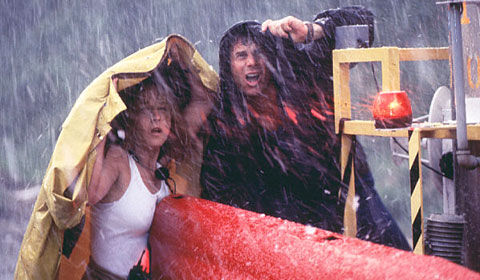
Twister helped me break into TV writing
At the time, actress Helen Hunt had a deal at Sony, where she had made the big disaster film, Twister. Sony was also the producer of her popular television series Mad About You. I wasn’t quite certain what we would do together, but we had a lot of great relationships with Sony execs who would be open to our projects. We set a meeting at their offices.
Helen’s lovely Junior Exec surprised me by bringing in her boss, the Head of the company, who had been Helen Hunt’s manager and was now her producing partner. Without a specific agenda, this was pretty much a blind date. We were getting to know each other and seeing if there was and chemistry.
The personal ad for a production company isn’t: “We like long walks on the beach, go to the gym every day and look equally good in jeans as in a little black dress.” Our introduction is our projects. Talking about the stories we are passionate about bringing to the screen is how we say, “This is what we like; this is who we are.”
After some chitchat about spinning – a form of exercise that still scares me – I launched into pitching our projects. I am a good pitcher. I was passionate about these projects, and I could pitch them while hanging upside down by my ankles over a pit of alligators.
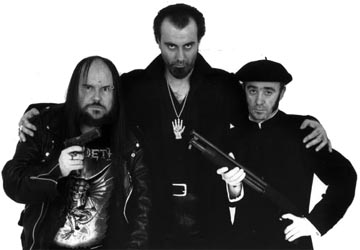
Delighted that there was a spark, I launched into our English language remake of an award-winning Spanish film, El Dia de La Bestia, The Day of the Beast. a dark horror-comedy about three very different men brought together to save the world from the pending apocalypse. It was edgy and offbeat, but Debra and I had responded to the great male characters, their arcs, and the quest. In our minds, it was reminiscent of The Fisher King, about two men and a quest, a very special film that Debra had produced which garnered numerous accolades including five Oscar nominations.
I was about to plunge on when the Producer stopped me. She really liked this idea. So did the Junior. Could they see the film? Umm, there’s no role for Helen Hunt here. The main character is a priest for God’s sake!
Could we change it? Make the priest a nun? Not really.
I knew this wouldn’t be their cup of tea, but they were excited. Although I tried, I simply couldn’t politely discourage them.
There was some interest in an original idea that Debra had for a film, the project I believed would be perfect for Helen. Indeed, it was a commercial idea, and later became the basis for a series that someone else produced before we could get it off the ground. But nothing could diminish their excitement about The Day of the Beast.
I returned to the office, chagrined at what I had inadvertently accomplished, and now had to report to my boss. Debra and I tried to strategize a way to get out of the screening. I had a one-page description of the film. I’d send it over and surely, with more information, they’d realize that it wasn’t for them.
Nope. They definitely wanted to set up a screening at the Sony lot.
From there, it simply snowballed. They wanted Helen to see the movie too. If Helen was coming, Debra had to join us. Since Helen was screening something, her Studio Exec was interested as well. As Helen was going to be on the lot, the President of Production wanted to stop by to say hello before we began. An innocent, “We like long walks on the beach” had turned into meeting the family and friends.
On the day of the screening, I was running late. Well, that’s pretty much a natural state of being for me. From our offices in Santa Monica, I hit the 10 Freeway, pushing 80 MPH in the fast lane headed for Culver City. I had to get there first.
I ran to the screening room, flung open the door, and was incredibly relieved to see that only Debra and Helen’s execs had arrived. Whew! I had time to go to the restroom and catch my breath.
Sprinting down the hall, I was back in a flash. I flung open the screening room door, prepared to rush inside – completely unaware that Helen Hunt was standing on the other side. I nearly knocked her to the ground; barely managing to stifle a scream. An excellent start.
Debra was enthusiastic. The Studio Exec schmoozed. The President of Production said a few gracious words, and then both left. We were ready to screen the film. I gave a short introduction, and as the lights lowered, Debra slipped out.
You may be unfamiliar with studio screening rooms. They are mini movie theatres with giant reclining chairs – plusher and wider than any seat you’ve ever paid fourteen bucks for. They make La-Z-Boys look anorexic. On the way in, you pass the projection booth, where there is a projectionist and your print.
In the center, a few seats have been removed for a control panel. It has nearly as many buttons as an airplane cockpit – few of which I could identify. There’s a phone that provides a direct line to the booth. I sat beside the console, picked up the phone and, feeling cool and in control, asked the man in the booth to please start the film.
It was just the four of us; with Helen, her Producer and the Junior Exec seated in the row in front of me.
The film began. Being in Spanish, it had English subtitles. The set up of this movie (SPOILER ALERT) is that a priest, who has dedicated his life to studying the Book of the Apocalypse – long believed to contain a hidden meaning – has finally unlocked the secret it holds – the exact date of the beginning of the end of the world. Turns out, it’s the day after tomorrow. He’s determined to go out into the world and commit as many acts of evil as possible to attract the devil and then trick him into revealing where the anti-Christ will be born, heralding the beginning of the end of the world, so he can stop it.
The little priest goes to his Monsignor in the Cathedral and, believing that the Devil could be listening, whispers his discovery while the church bells toll. As the secret cannot be heard in dialogue, there are no subtitles.
Helen leaned way back in her BarcaLounger and, with her left hand, beckoned me toward her. I uncrossed my legs and leaned toward her from the depths of my giant chair. “Crunch!” I kicked her directly in the diamond engagement ring. A very nice ring to be sure. Swell.
Helen whispered that she would like to have the volume turned up. Somehow, she failed to grasp that were no subtitles at that point because, just like the original Spanish-speaking audience, we are not mean to be privy to the whispered exchange.
Nevertheless, if that’s what Helen wanted, I was going to make it happen. Confronted by the baffling buttons, I tried not to panic. I picked up the phone and spoke to the nice man in the booth. Could he please turn up the volume? Mission accomplished. I relaxed back in my seat, satisfied that had been a problem-solver. I probably hadn’t permanently damaged Helen Hunt, and the ring – true to the mark of a real diamond – had remained intact. Disaster averted.
From there… it went straight to hell.
Helen Hunt crying – but not because of me.
Helen and her crew didn’t merely dislike the film; the dark parts literally made them cringe and cover their eyes. Witnessing their reaction meant that I was suffering right along with them.
I interjected a few times, trying to explain that many things would change in the adaptation. Our version wouldn’t include someone wringing the neck of a fluffy little bunny to make a cheap stew – it would be more like… Hamburger Helper.
But rabbit was the last straw for Helen and her crew. This wasn’t a screening. This was torture. I bravely suggested that we take a break at the midpoint. The lights came up, and I stood before the screen. Desperate to salvage the situation, I asked innocuously if they would like to watch the rest of the movie, or would they prefer that I tell them how the story ended.
Telling them was the unanimous choice.
We eventually hired a writer to do a terrific English language version of The Day of the Beast. There were definitely no dead bunnies.
We never found a project with Helen, but there was an unexpected outcome.
About a year later, I was watching an episode of Mad About You. At this point, Helen Hunt was not only the co-star, but a producer on the show. Half way through, Paul Reiser, the series star and co-creator, was on the couch watching a foreign film and chomping away on a big bowl of potato chips. Helen’s character, his wife Jamie, joined him.
“Paul?” she said sweetly.
“Yes, dear,” he replied.
“You’re chewing so loudly I can’t hear the movie.”
“Honey,” Paul said, “it’s subtitled.”
And just like that, I had broken into TV!
Everyone has their own story about breaking into TV writing.
What will your’s be?
Watch me break into TV writing on Mad About You, Season Seven, Millennium Bug episode here.