In my ScriptMag.com article, “The Tortoise and The Hare: A Tale of Two Writers,” I told the story of two screenwriters, one behaving like The Tortoise in oft told proverb and the other more comparable to The Hare. But in this story, unlike the fable, The Hare seems poised to win the race.
In my story, The Tortoise is a screenwriter who dragged out the rewrite process and burned himself out, ignored notes, and ultimately just wanted to get his spec out into the world. His agents and I reluctantly sent his high-concept spec into the marketplace. It was ably written, but fell far short of delivering the promise of the premise.
And that’s what the Internet tracking boards reported, essentially saying, “Don’t bother.”
Since then, we’ve had a conference call with the agent.
It was painful for everyone involved.
She filled us in on the feedback she had received on the script. Again and again she heard, “Great concept, be we don’t connect with the characters.” “Great concept, but it wasn’t there.” People loved the idea but the characters didn’t engage readers and the script failed to deliver on the promise of the premise.
“The town has spoken,” she said. “We have to listen.”
She won’t make any more submissions until there is a major rewrite. And even then, that tracking board bad rap won’t go away. Even if we could change the title, which we can’t in this case, people will see that it is the same writer and the same premise.
BREAKING & ENTERING LESSON: The town has a long memory. Always has. The Internet made the exchange of information rapid and permanent, but we’ve always kept records. Each studio has a Story Department, with coverage on every piece of material ever submitted. When I worked for a producer with a deal at Disney, the first thing we did when we got a submission was to call the Story Department to see if they had coverage on the script. Nothing under that title? What about the writer? If we found coverage on the writer, we would look at character names to see if it was simply the same script with a new title, which was the case more than a few times. I pulled coverage from the Disney Story Department on projects that had been submitted to Walt. WALT DISNEY!
After the call, The Tortoise was in shock.
I spoke to him for a few minutes, and he clearly needed time to process what he’d heard.
We’re now set to talk at then end of the week. I’ll see where he is at now, discuss options with him, and can only hope that he is open to really tearing this down and reworking the script. Even then, we will have to have a new strategy for bringing the script into the marketplace, likely by packaging it with an actor or actress.
As for The Hare, after pushing herself to meet the contest deadline, she rewrote the script to incorporate some of the minor changes from my notes. I read the new draft, and I liked it a great deal – but I didn’t love it. Not enough to commit to producing it. The characters were not as gritty as her concept, nor the dark world she had created, and the tone of the story. And character-driven material – combined with a big concept – is where my heart lies.
We had a lengthy conversation beginning with some key logic points. There is a fantasy element here against a real world backdrop. Those must always be perfectly defined with clearly spelled out rules. We were able to quickly resolve the issues here.
Then we dug into the characters. There’s a hero and a love interest, and both need to be more fully developed characters, become more dimensional and edgy, and finally, their romance can’t fall into place so easily and be believable.
This writer just gets it. It was a productive discussion. She is eager to dig in and add an entire new dimension to the script. I think this is the step that will elevate the entire piece and ensure that the story delivers, and the execution is flawless.
In the interim, The Hare had won a small contest and someone involved with the contest wanted to share it with producers who were looking for material. What to do? My advice was to compose a very polite reply, enthusiastic yet authentic. “You’re delighted that they are enthusiastic about your script, you appreciate their support but, you are in the midst of a major rewrite – as in no one can see it. And then mention that a manager who is a fan of your work is expecting the new draft. And you will be happy to keep them posted.”
BREAKING & ENTERING LESSON: As I’ve said before, as Orson Welles promised in the Paul Masson commercials, “We will sell no wine before its time.” If someone is enthusiastic now, then consider it an open door. Don’t rush through before your material is ready and have it slammed in your face.
There’s still more to be written here about The Tortoise and The Hare. But the lessons for screenwriters hoping to break into the business are plentiful.
I’ll keep you posted as the story unfolds.
Meanwhile, remember the moral of the story – to succeed as a screenwriter, you must be both The Tortoise and The Hare.
Take your time learning how to write a screenplay, but never stop moving forward as fast as you can.
Be steadfast in your vision for the story, but don’t hesitate to consider insight and input from others with a fresh perspective and experienced eyes.
Don’t focus only on the finish line, but when opportunity comes leap!
There are two great enemies to your success as a writer.
You might think it’s 1) not living in L.A. and 2) not having an agent.
But you’d be wrong.
Your time and creative juice are your greatest commodities as a writer. If you don’t have those, you won’t make progress. You are being robbed of them every single day.
You have to bring home the bacon, take out the trash, walk the dog, and put the kids to bed. Even if you do manage to carve out a little time, you can’t just turn on the creative juices on like a faucet and beautiful sentences will pour forth. One of the biggest obstacles to getting into the writing zone – that sweet spot where it just flows, is the siren song of distraction. It feeds on our fears and doubts and thrives on the human tendency to procrastinate.
This beast eats up minutes that turn to hours and consumes your energy and attention. Perhaps you are one of the few that is not afflicted. If so, lucky you!
I once had to stop writing a script to defrost the freezer because the icy build up was driving me mad. Eager to accomplish the task, I devised a special speed defrost technique that primarily involved a butcher knife. The Maytag Repairman wouldn’t recommend this.
“The Great Escape” starring Steve McQueen. Star in your own escape!
And now, neither would I.
What makes the killer of time and creativity a real horror story is that, all too often, “The call is coming from inside the house!” Perhaps you don’t feel like a prisoner trapped in your own workspace, but whether it’s your home office, your tool shed or a nifty set up on a studio lot, your regular writing space is packed with monsters and landmines there to sabotage you. Blake Snyder famous for the screenwriting book, Save the Cat. called this “Bungalow Fever” and advocated for “evacuating the premises.” Good advice.
Never underestimate the power of a change in location to switch things up. Routine has its advantages, but it can also become mind-numbing.
An afternoon or a day away can be refreshing. A weekend or a week in a new physical and mental space can truly reinvigorate you.
Screenwriting Retreats Around the World and Around the Corner
Experience exotic Costa Rica with Jacob Kruger. Long expanses of beach; yoga in the morning, movies at night and classes in between.
Dave Trottier will help you polish your script till it shines at Sundance.
Maybe you’d prefer a chateau in France with James Bonnet.
Screenwriter’s Summer Camp – A Retreat and a Career Boost
For me, when it comes to retreats I head for the hills, specifically a getaway to the mountains. This June I’m off to Screenwriter’s Summer Camp!
I’m thrilled to be returning to Idyllwild Arts Summer Program and teaching a weeklong intensive, Screenwriting Revolution: Creating and Marketing Successful Screenplays, June 16 through 20. It’s held in Idyllwild, CA, two hours East of Los Angeles, a half hour uphill, in the mountains above Palm Springs.
And since we’re so close to L.A., on our final day I’ll be importing high-level industry professionals devoted to getting to know you and work with you. Trust me, you won’t find these folks at a Pitch-a-palooza at any price, much less sitting across the table from you at lunch.
Maybe you’re not feeling as if you need to tunnel your way out of an escape-proof POW camp, but this is the opportunity to get away from work, family, friends, Facebook and give your career an enormous boost.
Screenwriters at all levels of experience and proficiency will build the skills, knowledge, concepts, and relationships needed to make breaking into the industry a reality. Develop ideas with expert guidance, hone essential professional skills, and gain invaluable personal and industry insight. Establish real industry relationships.
Spend a week focused on understanding the industry from the inside and how to use that newfound knowledge, create and develop concepts that will ignite industry interest. Discover your passions and your strengths to elevate your stories. Master the art of pitching with skill and confidence. Gain powerful tools, techniques, and templates that will revolutionize your writing process, making it faster and more successful.
Advance Assignments will take you on a journey of self-discovery, spark creativity, and give me insights into making your week truly transformational. You will thrive with intimate, one-on-one work, benefit from group exercises, and see structure with utter clarity as we watch and discuss a film together.
Our week culminates in a day spent developing relationships with three working industry professionals – an agent, development executive and studio executive or manager. Since we’re so close to Los Angeles, they’re leaving their offices to join us.
We begin with introductions and Q & A in the morning, and then enjoy getting to know one another on a personal basis over lunch. The afternoon is devoted to listening to your polished pitches, with a generous amount of time to provide feedback on concept, market potential, pitching technique, as well as advice on how to move your work forward in the marketplace.
When you’re not in class or writing, discover why Idyllwild is best described as “idyllic.” It is the ideal location for a screenwriting retreat. This quaint, yet sophisticated mile-high town has more elevation than population and is home to the arts and artists of all kinds.
You won’t find is parking meters, traffic lights, or a rush hour.
There are unique shops to explore; offering handcrafted art, clothing and “build-your-own” ice cream bars. Enjoy little ethnic restaurants, as well as gourmet fare with live music playing on the patio. There’s even a movie theatre, with one movie playing twice a day, and the only video and DVD rental store in its lobby!
Take a hike. Wander the fabulous trails or hit the challenging ones. Unwind to the sound of the wind whistling through the tall trees, inhale the pine-scented breeze, contemplate the spectacular vistas.
Retreat = Relax, Energize, Tune In, Realize, Evolve, Advance, Thrive
No matter where you choose go for your retreat, even if it’s just the local library or a cool coffee shop, “Get out, get out, get out of the house!” Give yourself and your career the time and energy they deserve.
Send yourself to Summer Camp! Get what you need to succeed.
You deserve answers. You won’t be satisfied until you get them.
So occasionally, I’ll be handing my blog over to my darling friend, Dr. Paige Turner, to address your most perplexing questions. The ones that keep you up at night, tossing, turning, tortured.
I have every confidence Dr. Turner will deliver just what you are craving.
The floor is entirely yours, Dr. P.T.
Dear Dr. Paige Turner,
How do I know my script is done and ready to be in front of the eyes of the industry?
Should I just keep endlessly rewriting?
Yours Truly,
Uncertain
Dear Truly Uncertain,
You pose an excellent question.
Unlike in other pursuits, there are no subtle clues when script is finished. No heavy breathing, no groans of pleasure, no one calling out your name or even inadvertently moaning, “Oh, Bill, Bill, Bill Goldman.”
But, if you are aiming for fireworks, here are some things to take into consideration:
Have you devoted enough time to foreplay?
There’s plenty of groundwork to be laid before one starts caressing the keyboard. If you hope to send tingles down your reader’s spine, you had better know your way around your story’s spine. Did you devote yourself to planning your screenplay before typing “Fade In?” Whether you use corkboards or computer programs, prewriting is a key strategy for scoring.
Is there chemistry?
Your idea should grab us right from the start. As your story is revealed, we should find it intoxicating. A little unpredictability is hot. Your every move feels deliberate, designed to turn us on. Every element of your script comes together, supporting the core concept. Your hero drives the story. The conflict builds and escalates relentlessly toward the climax, leaving us breathless. Of course Truly, I don’t need to tell you that there’s no happy ending without a satisfying finish.
Was it good for you too?
It’s easy to be impressed with your own performance. After all, you gave it your best moves. This is your baby. It’s nearly impossible to be objective about it. Chances are you are so caught up in the lush fantasy movie unspooling in your mind, that you may not realize what is missing on the page. Get some fresh eyes. Start with writer friends who offer reliable, constructive feedback on your latest rewrite. Beware those wingmen who fake it with over the top flattery, as well as those who attempt to turn your story into their story.
Are you scoring in contests or repeatedly striking out?
Many writers turn to contests to gage their writing, and send in a rewrite the next year to see if it scores higher and makes the cut. This can be a lengthy and slow process. Research contests and what they offer. Search for the right fit. Find out other writer’s experiences. There are so many out there. I recommend MovieBytes for the inside scoop – created by a writer, for writers, and jam packed with info and opinions from those who have come before you.
Before you’re through rewriting, spend some time with a pro.
The opinion of a well-respected professional who has been around the block a few times will cost you, but their opinion is well worth it.
The short answer: You can’t tell.
That’s why I recommend a pro to bring you some fresh insights and offer constructive and objective advice. Be sure to check them out first, and get some recommendations from other satisfied customers!
Is your script turning us off before we even turn to Page 1?
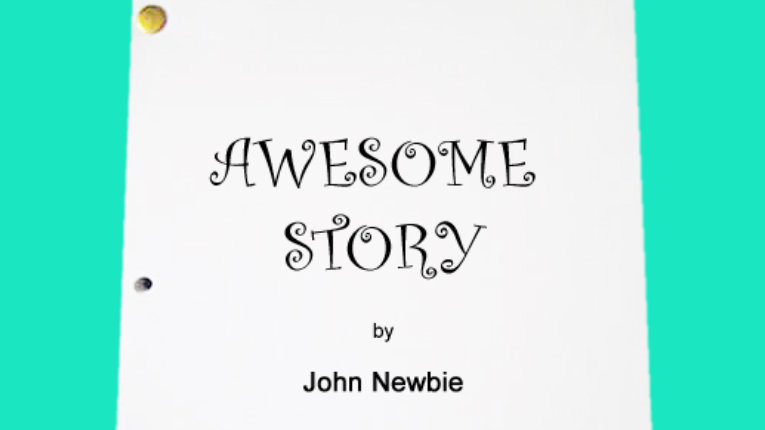
This cover page screams Newbie Writer!
You might be surprised to learn that your cover page speaks volumes to industry pros. You can convince us you are an inexperienced screenwriter before we even open your script. Your cover page is more telling than you think.
No Special Fonts For The Title
Stick with 12 point Courier or Courier Final Draft. It’s what we’re used to. You don’t gain any points for a unique cover page. And your time is better spent proofing your script than searching for a clever font.
Don’t List The Draft Number
Not only do we not care, but if it is your seventh draft we may think you are a one trick pony, endlessly rewriting the same script. On the other hand, why would you brag that it’s a first draft? That says it probably needs to be honed and polished. Draft information is for you only unless you’re working on a project in active development. Then we’re looking for a draft date not a draft number.
No Draft Dates
No matter when or why we are reading it, we prefer to feel it’s new rather than a piece of material that’s been around the block. Back in the dark ages, the agent I was working for had me white out the draft date on a script before copying it and sending them out. All scripts should feel brand new. It makes them seem special. If something is just now going out, there’s more buzz than there is for a script that has been lying around.
Just The Facts Ma’am
TITLE, all caps centered. No need to underline.
Contact info in the lower right corner, near the bottom of the page, left justified:
Your name. Your address. Your phone number. Your email address.
Registration
You can add a WGA registration number or US copyright number in the lower left hand corner of the page. Left justified.
The Look
When printing out a script on paper, offset the margins to allow for brads. Back in the olden days, we’d make the left margin about three-quarters of an inch wider than the right to account for brads or, more often, script covers which might have a fold as wide as an inch. Take a moment to measure so your title is really centered.
Honestly, none of these no-nos will keep anyone from reading your script. You might get an eye roll, but we’re still going to turn the page and hope for a great story.
Back in the olden days, when screenplays existed on paper, aspiring writers devoted an astonishing amount of time to discussing how many brads a script should have. It was fodder for heated Internet debate. What a waste! As if the number of brads would get your script read any sooner or taken any more or less seriously. For the record, as someone who sustained more than one brad injury toting around stacks of scripts: a) two and b) not the cheap ones.
Now that we’re not counting brads, there’s more focus than ever on page count. There’s no hard and fast rule here; don’t let anyone convince you otherwise. What counts is what makes you look like a professional. You’re in the zone at approximately 103 to 118. Approximately!
Remember, each page of script translates to a minute of screen time, so the running time of what’s in movie theatres is a guideline. One hundred and twenty pages is a 2-hour movie – plus credits. But those guys getting movies made can break a heck of a lot more rules than a new writer trying to break into the business.
Does page count count?
As a producer, if you’ve gotten so far as to have me request your script, I’m going to take a look no matter what. I think any industry professional would say the same. Whether it’s too long or too short, you’re still going to get read. Page count, however, is one of the ways you make a first impression as a writer.
If we receive a 133-page script, we may suspect there’s a focus problem or that the writer hasn’t edited and tightened their work. But honestly, if I’m reading 133 pages of a great script, I am not an unhappy camper!
If a screenplay is 83-pages, we might guess that the story and/or writing is thin and perhaps the writer hasn’t dug deep enough. It’s also possible that the script is too lean because there’s more in the writer’s head than is on the page.
If you turn in a 153-page script, you look like a green writer who is unaware of industry fundamentals. You absolutely cannot fool us with cheating the margins and make that 153-page behemoth pass as a svelte 112. We can instantly tell when formatting is off. Don’t fudge it.
Page count counts, but it is not what seals your fate.
Each word counts by leanly painting a rich picture. Each character counts by serving a significant function in the story and supporting the theme. Each scene counts by advancing plot and revealing character – preferably both. Each effective twist or intriguing reveal delights our story-loving brains. Each time conflict escalates you’re adding tension and heightening the stakes. Every time your story creates a visceral reaction in us, you’re drawing us in.
These are the things you should be “counting” before sending your script out.
Why? Because size DOESN’T matter when the writing is strong and the story is compelling.