Back in the olden days, when screenplays existed on paper, aspiring writers devoted an astonishing amount of time to discussing how many brads a script should have. It was fodder for heated Internet debate. What a waste! As if the number of brads would get your script read any sooner or taken any more or less seriously. For the record, as someone who sustained more than one brad injury toting around stacks of scripts: a) two and b) not the cheap ones.
Now that we’re not counting brads, there’s more focus than ever on page count. There’s no hard and fast rule here; don’t let anyone convince you otherwise. What counts is what makes you look like a professional. You’re in the zone at approximately 103 to 118. Approximately!
Remember, each page of script translates to a minute of screen time, so the running time of what’s in movie theatres is a guideline. One hundred and twenty pages is a 2-hour movie – plus credits. But those guys getting movies made can break a heck of a lot more rules than a new writer trying to break into the business.
Does page count count?
As a producer, if you’ve gotten so far as to have me request your script, I’m going to take a look no matter what. I think any industry professional would say the same. Whether it’s too long or too short, you’re still going to get read. Page count, however, is one of the ways you make a first impression as a writer.
If we receive a 133-page script, we may suspect there’s a focus problem or that the writer hasn’t edited and tightened their work. But honestly, if I’m reading 133 pages of a great script, I am not an unhappy camper!
If a screenplay is 83-pages, we might guess that the story and/or writing is thin and perhaps the writer hasn’t dug deep enough. It’s also possible that the script is too lean because there’s more in the writer’s head than is on the page.
If you turn in a 153-page script, you look like a green writer who is unaware of industry fundamentals. You absolutely cannot fool us with cheating the margins and make that 153-page behemoth pass as a svelte 112. We can instantly tell when formatting is off. Don’t fudge it.
Page count counts, but it is not what seals your fate.
Each word counts by leanly painting a rich picture. Each character counts by serving a significant function in the story and supporting the theme. Each scene counts by advancing plot and revealing character – preferably both. Each effective twist or intriguing reveal delights our story-loving brains. Each time conflict escalates you’re adding tension and heightening the stakes. Every time your story creates a visceral reaction in us, you’re drawing us in.
These are the things you should be “counting” before sending your script out.
Why? Because size DOESN’T matter when the writing is strong and the story is compelling.
Ah, the Internet. The heck with sliced bread – this is the most incredible invention of our lifetime! I wouldn’t dream of writing an article or blog without Wikipedia and Thesaurus.com open in my browser. Plus Facebook for when I need a bit of distraction.
But it is also the most effective way to spread misinformation known to humankind. Writers aiming to break in are especially susceptible. Hungry for information, the secret formula to gain entry to the insular world that is the film business, they will cling to anything that promises to get them in the door.
In this electronic age, the endless debate over two brads or three has finally, thankfully become irrelevant. It was a massive waste of time and energy. If, by chance you are still pondering this, see my ScriptMag.com article “Does This Script Make Me Look Fat?” under “Don’t Sweat the Small Stuff, Sweat the Small Stuff.”
But there’s plenty floating out there in cyberspace that is sheer folly. Or worse, harmful.
Busting these screenwriting myths fills me with glee. I hope it saves you time that could be better spent coming up with great ideas or strengthening your script.
Logline Myths
Is crafting a logline making you tear your hair out in frustration? While loglines can be challenging, there’s not need for them to drive you crazy.
Apparently there’s a rumor going around that loglines must be no longer than 25 words. I’ve also heard 27. This happens to be the most current and most insidious myth out there.
Writers are spending time and energy struggling to stick to a rule someone made up that I’d never heard of in 25 years in the business. I’ve since heard rumblings that 25 word bloglines should include one comma. Then I heard two. Seriously? Do you think we have the time to count words? We’re looking for ideas for movies!
This kind of misinformation hurts writers. Perhaps whoever got this ridiculous ball rolling will be offended. Great! Let’s kick up a lot of noise about this one because, even if it was well intentioned, it’s wrong, wrong, wrong and deserves to be dead and buried.
Because of this myth, I’ve received queries with loglines I simply couldn’t figure out. The loglines were so brief and vague they left me with more questions than answers.
In one case, I could see there was a little something intriguing in this itty bitty logline, but it was so thin I couldn’t get the story. In the other, the writer failed on so many counts that I was bewildered as to what the script was about.
One of the baffling 25 word loglines – which despite its brevity managed to include a grammatical error – left me with at least 50 words of questions. I sent them to the writer. To clarify, he added a single word. I still couldn’t figure out who the hero was or what was going on and asked more questions. Finally, he relented and gave me two sentences that more or less made sense. At least I could figure out what the story was about.
Want proof? You be the judge.
Logline Version One – 29 words, two commas:
When a gigantic great white shark begins to menace the small island community of Amity, a police chief, a marine scientist and grizzled fisherman set out to stop it. (via IMDb)
Logline Version Two – 42 words: one comma:
Horror. When a Great White shark terrorizes a quiet New England beach community, the town’s police chief must overcome his fear of the water and join forces with a grizzled shark hunter and an oceanographer to hunt it down to save the town.
Which version is visceral?
Which includes extraneous information?
Which is the most effective in giving you a sense of the story?
Which communicates the tone of the film? Which has unnecessary adjectives?
Which makes it clear who the hero is?
Which conveys the stakes?
Which logline would make you most likely to ask to read the script out of a stack of hundreds of queries?
There is really only one Logline Law – clearly convey the story in a way that makes it compelling and expresses what the movie feels like. If you don’t do that, you fail.
And no loglines without genres ever!
Look Ma, No Articles!
There was a freaky myth a few years back that in order to make your script a “fast read,” cut out all of the articles – no “a’s,” “and’s,” and “the’s” in the entire script. This destroys the reading experience making it a sentence-by-sentence struggle. Next cut all extraneous words, aiming for the lowest page count possible.
I was in the unique position to have read two different versions of the same script, first pre-tightening and then after following this advice. The story was set in an idiosyncratic small town and filled with charmingly quirky characters and focused on a zany romance. The offbeatness was central to the story and gave the piece its own unique appeal. In the first version I enjoyed the writing and the read.
The second version came to me as a mentor at the awesome CineStory Screenwriting Retreat. As one of this writer’s mentors, I would be spending an hour and a half with him in a constructive conversation about his script. I set out to read it again. This version was much shorter, well under 100 pages. The writing was thin. The story flat. The town and characters, colorless. It wasn’t an enjoyable reading experience. What happened?
The moment I sat down with the writer, this was the first question I asked. He admitted to having read somewhere online (red flag!) that cutting out all the extraneous words would make a script a “fast read.” What was left had virtually no articles – the “a” “an” and “the’s” that are part of normal sentence construction.
And he had cut every adjective possible. Remember what I liked about the first version? Gone thanks to this Internet advice. No adjectives = no unique, quirky charm.
This is not the way to create a fast read. It’s not about words or even page count. A fast read is any script where you simply can’t wait to find out what happens next. When as a reader, you’re so intrigued you fly through the script, burning through the pages.
Can your First Script Sell? Getting Your Foot In the Door
You’ve finished your first script!
Now what?
According to Wikipedia, Foot-In-The-Door isn’t just a moniker applied to pushy salesmen and census canvassers; it’s an actual behavioral phenomenon.
“FITD technique is a compliance tactic that involves getting a person to agree to a large request by first setting them up by having that person agree to a modest request.”
“FITD works by first getting a small ‘yes’ and then getting an even bigger ‘yes.’”
Once a person has agreed to the small request, they’re more likely to go along with even larger requests.
Here’s how:
Aim low.
Hunt for people who are hungry. They need you! They’re looking for you. They’re starving for that great idea or talented new writer. Be the needle in a haystack Grasshopper.
You have the best shot with assistants eager to be promoted to development execs and newly minted development execs, as well as agency assistants hoping to become agents and the brand spanking new Young Turks. They have the most to gain from “discovering” your project.
Target your query letters to them. Aim carefully. Know what their boss/company likes – whether from reading about their projects, sales, online interviews or job announcements – and pitch that to them. Do your homework!
“The best way to get an agent is for someone in the business to recommend you to an agent” seems like a vicious conundrum for aspiring writers. If you find the hungry exec at a production company where the company principal, aka 3000 lb. Gorilla, might be interested in your project, they are THE perfect person to get you an agent. Asking the right person to read your script can lead to asking them – or them offering – to get you an agent. FITD!
Young Exec gets points for finding a potential project and a promising writer. Since she has been busily building relationships with new agents who are moving up the ranks side-by-side with her, she knows Eager Agent who needs clients. Young Exec offers him a known quantity, not a script that was just “thrown over the transom.” She’s pitching the agent a writer she thinks is talented, possibly with a project that’s already getting some traction.
It’s the film industry version of matchmaking.
If Eager Agent and Aspiring Writer “hook up,” Young Exec is everyone’s darling. She will likely get a little special consideration: an early look at Aspiring Writer’s next project, and will be “on the list” when Eager Agent goes out with Aspiring Writer’s next spec. It’s a win-win-win. This is how career-long industry relationships are cemented.
I was fortunate enough to work as a development exec for writer-producers Bruce Evans and Raynold Gideon (Starman, Stand by Me, Mr. Brooks) early in my career. They landed their first agent when she was a young agency assistant. They stayed with her for decades while she became a mega agent at CAA until she left to run a production company for a 3000 lb. Gorilla.
Hire yourself to be your own agent.
The agency business is all about information. That’s why those folks are going out to breakfast, lunch, drinks and dinner, sometimes all in one day, not to mention “running the lot” – heading to a studio and meeting with everyone they can. They’re building relationships and gathering info on who is looking to buy what so they can sell it to them, as well as open assignments they can fill with the agency’s clients. That’s what agents do, hunt and gather info, then use it to make money.
As your own agent, think of yourself like a relentless shark gathering info on who wants to buy what. Never has information been so readily available as it is now via the Internet. What (and who) did well at the box office last weekend? That’s what the studios are looking for.
Whether you’re reading Variety, The Hollywood Reporter or Deadline Hollywood, take note of the genres that are selling and who is buying. Just like an agent, pay attention to the announcement of new studio deals. The studio is highly motivated to buy for a new company whether it is producer, star or director-driven. The studio made the deal because they felt it would lead to making movies that, based on the producer/director/star’s track record, would make money. If the company and the studio don’t start developing projects together, then there’s zero chance of the studio making money and they’re already spending money to fund the production company. Likewise, at the end of a deal – typically anywhere from 18 months to as long as five years – the studio is less motivated to buy.
The late Tom Jankiewicz was a substitute schoolteacher when he wrote Gross Pointe Blank. He was probably the gentlest and tallest person I have ever met. He described to me how he read the trades religiously, using the information he gathered to send out countless queries. When he read that an actor, Kiefer Sutherland, had a deal and studios were buying things for him, he sent a query to his company. Kiefer was attached for a time and, even though he ultimately wasn’t involved with the movie, it got the ball rolling and Tom got his movie made. FITD at work!
STOP thinking about selling the script; think about the script selling you.
Selling a first script off of a query letter is an extreme long shot. Nearly impossible. What’s NOT impossible is having a terrific script launch your career.
Think of your script as a description in an online dating service. You like long walks on the beach at sunset, your genre is high-concept comedies, and you write distinctive, dimensional characters. Your script introduces you to us.
According to Shane Black, one of the most successful spec script writers of all time, “It’s a difficult spec market. Practically nonexistent. But my advice would still be, if you’re going to get in, get in with a spec script – and this is my experience, said Shane in a recent interview in anticipation of the opening of Iron Man 3 which he co-wrote and directed. “The first script most people write probably isn’t going to sell – mine didn’t! People might be interested in it, they might like the writing, and that encourages them to hire you for something else. They might say, ‘Yeah, he’s pretty good. Let’s get him in to do the next draft of our film that’s in production.’”
If I read your script, even if I don’t want to produce your script, if I think you’re a talented writer with marketable ideas, it’s in my best interest to build a relationship with you. We all need material. You create material. We need to know talented new writers. Hopefully that’s you. It’s in my best interest to get to know you and to find out about what you’re writing next. That might well be something I am excited about producing.
That script doesn’t have to sell to move you forward.
One of the most amazing FITD stories I know is from Glenn Gers, writer of Fracture and Mad Money. Glenn wrote his first script in 1984. It got him an agent right away. “People liked it. No one would make it, but they liked it,” says Glenn. “They offered me jobs writing other scripts.” Five years later, it was optioned by a major producer for a year. Five years after that, it was optioned by a studio for A-list stars. “I was then fired off it,” explains Glenn. “Three years later I got it back. More stars and directors have wanted to do it since; one got a company to finance it but then the company went out of business.” Here’s what blows my mind, according to Glenn, “A producer and director I think are great are currently trying to cast and finance an indie production.”
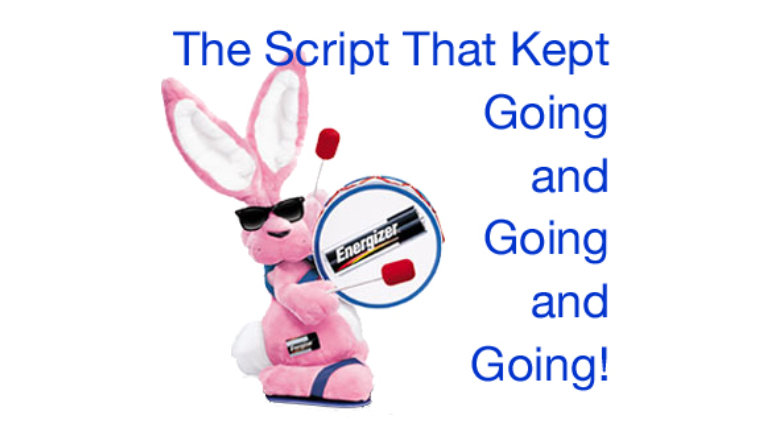
The Energizer Bunny of FITD scripts! Almost 30 years and still going.
Wikipedia has one more piece of advice for people trying to get a “yes.” The reverse approach – “making a deliberately outlandish opening demand so that a subsequent, milder request will be accepted – is known as the door-in-the-face technique.”
I don’t recommend it as that’s exactly the position you’re likely to find yourself in!
It’s the single most important decision you will ever make as a writer.
Faster than a speeding bullet, able to leap tall building in a single bound, a great idea is the most powerful thing in the film business. A terrific idea can catapult you from “the outside looking in” straight into the center of the film industry. Possibly one of the toughest occupations to break into, you need a lot of leverage just to get your to toe in the door. A great film concept is the best crowbar imaginable. Ideas are the key to breaking into the business.
How important are ideas? Don’t take my word for it. According to George Lucas, a guy whose understanding of powerful movie ideas has left an indelible mark on our culture, “A movie is a success or failure from the minute you solidify the concept. Execution is 50 percent. It is the primal attachment to the concept that makes the movie work or not work.”
But hey, let’s not take George’s word for it. Try this one by Terry Rossio who with writing partner Ted Elliot wrote ALADDIN, SHREK, and the PIRATES OF THE CARIBBEAN FRANCHISE. That includes a couple of number one world wide box office hits and an Academy Award®:
“The very first decision you make as a writer – ‘what is my film about’ – will define your creative instincts in the eyes of the industry. As a screenwriter, your choice of film premise is your calling card. Not your witty dialog, not your clever descriptions. Not your knowledge of structure and subplot and subtext… You must – you MUST – choose well. Most aspiring screenwriters simply don’t spend enough time choosing their concept. It’s by far the most common mistake I see in spec scripts. The writer has lost the race right from the gate. Months – sometimes years – are lost trying to elevate a film idea that by its nature probably had no hope of ever becoming a movie.”
Don’t leave the choice of what to write next up to chance!
A great idea for a movie is the most powerful thing in the film business. I call these story concepts “Hooky Ideas.”
A Hooky Idea immediately intrigues our minds. It makes you want to know more, gets you hooked and sticks with you. When it comes to story, human brains, developed over millions of years of telling stories, love to be surprised by something we never saw coming. We adore clever twists, and our minds are turned on by a completely new spin on something we’ve seen before.
A Hooky Idea puts images, feelings, tone into your mind in just a very few words. When you hear a hooky idea, you know what the movie will FEEL LIKE. And you can tell who the audience is. You immediately know if this is a movie that you want to see. Or not. But you can tell right off the bat.
So how to you target the what write next? Here’s an essential check list for determining if you might have for a Hooky Idea.
THE LITMUS TEST: A hero we can ROOT for trying to achieve a tangible goal (LOVE, SUCCESS, POWER, SURVIVAL, THWARTING ALIEN INVASION…) despite OBSTACLES (I.E. CONFLICT) that stand in their way.
CONFLICT IS KEY: It’s what makes movies. It drives the story forward. If you aren’t sure if a short story or an article in the newspaper has the potential to become a movie – this is the surest test. Without conflict you not only don’t have a Hooky Idea, you might not have a movie idea at all.
EVERY GOOD STORY HAS STAKES: Without something meaningful to be gained or lost, who cares? Not the audience.
THE “COOL” TEST: Is it new, clever, fun, a unique twist on something we’ve seen before, give us something new, something fresh even uniquely derivative?
Is it VISCERAL? Movies should move us. We go to the movies to have a visceral experience. Horror movies better be scary. Comedies should make us bust a gut. Mystery should be filled with twists and reveals that astonish and amaze.
TIMELY OR TIMELESS? Hooky ideas have a timeless quality to them, whereas, other ideas may be timely, these films are viewed again and again by subsequent generations. THE THREE MUSKETEERS has been filmed at least twice every single decade since the invention of the medium. Beware of timely ideas about current events or issues, as they limit you and may not speak to a large audience.
IS THERE A PROTOTYPE? Can you think of a successful film in your genre? A strong prototype film exemplifies their genre. Their big structure beats will be the same no matter what details are original to you.
AUDIENCE: Will anyone else feel the way you do about your idea? Don’t be afraid to pitch it. Pitch it to your friends, your partner, your kids. Strangers, someone you’ve met on a blind date. Do they want to know more? Would they go see this movie? If it’s only of interest to you and your mom then there’s no audience for the movie.
IS IT PITCHABLE? Your best chance for success is with a high concept, pitchable idea. If you choose an Execution Dependent idea, the charm, the appeal, the deliciousness, and the ultimate success of the film is in the details not the concept making it nearly impossible to get industry attention from a query or pitch.
THE PASSION TEST: Are you passionate about making this movie? You’d better be – you’re going to spend years of your life on it. Is this idea worth spending years of your life on? And what doesn’t excite you, can’t possibly turn someone else on.
More powerful than a locomotive, a Hooky Idea is best way to decide what to write next and muscle your way into the industry!
The Other Side of The Desk: The Inside Scoop on Pitching
As a producer, I’ve been in every pitching situation imaginable, on both sides of the desk.
I’ve heard thousands of pitches from writers. I’ve brought pitches into every studio, often with A-list writers, directors and stars attached. From swank studio conference rooms to a cramped office inside an aged production trailer, I‘ve been there, done that. I’ve set up a cable film with a phone call and a newspaper clipping. With a single submission, I’ve set up a studio project based on a few sentence description of a short-lived TV series from decades past.
I’ve had execs thank me profusely for bringing in such an impressive story – and then pass. I’ve suffered through an exec who’ve failed to mask their dislike of a concept from the first minute, as well as an exec who failed to keep her eyes open in one of the most dynamic action dramas ever, until the arrestingly handsome writer jumped up and began acting it out.
I was listening to a pitch from a writing team, when the door to my office opened revealing – for my eyes only – a movie star clad only in his tidy whities. Shocked as I was, he expected to find his costume designer on the other side.
I’ve taken these experiences, the good, bad and downright painful, and become a Pitch Doctor. I specialize not in getting people to “Open up, stick out your tongue and say “Ah,” but to get them say “Ah-HA!” by helping them discover what to pitch, how to pitch and how to use pitching as a fast track to success.
When I first began teaching the art of pitching, I turned to my friend, the late Blake Snyder of Save the Cat fame, and asked, “What do writers really want to know about pitching?”
Blake insisted that what he and all other writers wanted was what we – the execs – are thinking in a pitch meeting.
What’s going on in our heads?
So here are some secrets from the other side of the desk – what executives won’t likely tell you in the room.
What really matters in a pitch and what simply shouldn’t be said.
Know the mistakes guaranteed to sink your pitch and the surefire ways to slam dunk it.
SEVEN SLAM DUNKS
Pitching perfection. Nothing but net!
A great hook – we can’t get it out of our minds. What I call a “Hooky Idea.”
You surprise us. We’ve heard it all, so actually fresh story, a twist we truly didn’t see coming, grabs us. A completely new twist on something we’ve see before is a total turn on.
We can immediately think of Male Stars for the hero, or better yet, Two Male Stars for the two leads.
We see trailer moments and a one-sheet.
You pitch something somehow similar to whatever was a huge hit or surprise success at the box office last weekend – but different.
You have a potential Four Quadrant concept, meaning it hits all segments of the movie going audience.
We know how to sell it and who will buy it – the Number One way to succeed.
SEVEN WAYS YOU’RE SUNK
It’s Execution Dependant! The deliciousness is in the details, not the concept. The Number One way to tank, as you simply cannot succeed. This should not be pitched – EVER. Go spec it. Write something marvelous. It may take you a hundred drafts, but ultimately it makes people passionate to bring it to the screen. Even if it doesn’t get sold, execs will want to have a project with you.
TEN seconds in the wrong world – not the world of your story – and we’re gone. If you don’t tell us the tone of your movie, we’ll start making it up in our heads. And it’s not likely to be the movie in your head. You will never get us back. There’s a very old saying, “There’s a fine line between comedy and tragedy.” And the reason it’s a very old saying is because it’s true.
We can’t follow your story. Where are we in the world, if it’s not here and now? Where are we in the story? Is this Act Two or still Act One? Take us by the hand and have your hero lead us into your world and your story.
We already have a project like it. We’ll cut you off immediately. We don’t want you to sue us for stealing your idea – an idea that we’re already developing. Don’t take it personally. If you don’t have something else ready to pitch, learn what we are looking for and get out. Live to fight another day.
You hit the genre we just “don’t get.” Everyone has them. Perhaps it’s just not our cup of tea; a story we don’t respond to for personal reasons. Be especially wary of black comedies and spoofs, which are very few people’s cup of tea.
Your idea does not fit our mandate. Do your homework; know who you’re pitching to. Don’t bring a girl’s coming of age story to Joel Silver’s company. Don’t pitch a story about toys that come to life in the attic to Pixar. Yes, that was a real pitch. Can’t make this stuff up.
All hat and no cattle. Academy Award® nominated writer Mark Fergus calls this, “All rocket, no bottle.” It seems like a hook, but there’s nothing to support it. The pieces don’t fit together. It sounds cool, but it makes no sense, has no structure and lacks the Essential Elements of story.
AND ONE BONUS as I’m seeing this so much lately in pitches and queries:
Never, ever tell us how successful your project is going to be. That there will be sequels, action figures and theme park rides. Even top studio marketing execs can’t determine this, so it makes you look like an amateur.