So, you’ve heard of this thing called a “writers’ group.” But what is it, why is it and who is it?
A screenwriters’ group is a collection of creative people whose passion is to create stories that can some day be shared with millions. Members of said groups cram around a kitchen table with pots of coffee and tea, providing each other with feedback, inspiration and ideas – all to make their scripts as great as they can possibly be. A writers’ group can help you create a screenplay that not only your mother will love, but that will make the powers-that-be in Hollywood sit up and take notice.
Why be Part of a Writers’ Group?
The first reason is simple. Writers write. Period. And a writers’ group can help foster the sometimes excruciating discipline of putting pen to paper – of getting those ideas out of your imagination and into the world. Ask a working writer how often they suffer writer’s block. They don’t. And why? Because they have a deadline, they have structure. They have people counting on them. They have a waiting audience. A writers’ group can be that audience – the impetus to stop researching an idea to death, dreaming it to death, thinking it to death – and finally committing those words to paper.
The second feature of a writers’ group is no less important. Now that you’ve written something, it’s time to let your words out into the big, bad, scary world. This can be daunting – it’s like sending your baby off to college, hoping he or she will be popular, successful, happy – and loved. But you can’t protect and defend your words forever; you must let them fly on their own wings. Yes, there’s comfort in hiding your masterpiece in your hard drive, under your bed, or in the recesses of your cerebral cortex. But to become a real writer, a communication must happen – and this requires an audience.
Writing is a Lonely Affair
Brilliant ideas can grow stale in your head. Repetition can convince you that good stories are broken, or that flawed stories are structurally sound. A writer needs to hear other voices. Voices to challenge your material – to love it, hate it, to be confused, to be thrilled. In short, you need feedback. And lots of it. Amazing things happen during open communication. Sparks fly between people. Magic erupts. Meaning is illuminated.
A writers’ group will help you to develop vital muscles – the muscles to listen.
The biggest complaint about writers deemed “not ready for primetime” is this: they don’t know how to listen. Good writers learn to ease up on their defense mechanisms; they listen, not only with their ears and their intellect, but with their heart, their whole body. This has nothing to do with lowering one’s standards, learning to agree with your peers, or subscribing to groupthink. This is about taking the opportunity to experience yourself and your writing through the eyes and perceptions of others. A writer is so close to their material, they often lose sight of the big picture. Sometimes they’re writing instinctively, and aren’t even sure what the big picture is. Feedback from trusted colleagues is an incredible chance to see things anew, to enlarge your perspective, and to illuminate fresh creative possibilities.
Not all feedback is right – or even useful. And dealing with conflicting notes can be overwhelming. That’s part of the learning curve – sorting through the feedback that speaks to you, and that which does not. As a writer, you will get notes throughout your career from many different sources. All the process requires is this: consider every note or comment an opportunity to make your script better. To turn over a stone that may have been missed. You’ll see patterns in your writing, good ones or bad ones, through the reactions of others. You’ll learn what people respond to, and what they don’t. You’ll learn to decode the “note behind the note” – what the reader meant, even if it wasn’t articulated gracefully. “Add flying monkeys in Act 3” might be an encrypted version of “I lose interest in your hero’s journey right at your story’s climax…”
How often will “listening” help your writing? Exactly 100% of the time.
Those are a few reasons “why.” Now for a few nuts and bolts!
Getting Started
Let’s say you don’t live in Los Angeles and are trying to form a group. One good way to unearth potential members is dig into social media and put your feelers out. Check for local groups, or set up one of your own.
Electing a Moderator
You’ll need someone to structure things for the group. Someone organized, someone responsible. Your moderator will schedule the meetings, choose locations, and make sure the sessions run smoothly. He or she will spearhead the screening of potential members, as well as set the rules and expectations for each. Elect a moderator (maybe it’s you!), and have a backup “deputy” should you be unable to perform your duties for any given session.
Screening Potential Members
Just as every good story has its tone, so does a good writers’ group. Who do you want in your group? Harmony is certainly beneficial, but let’s not get carried away. You don’t want to be in a group of writers who are just like you, love the same stories you do, and who nod in polite agreement at everything you write. Just as good drama thrives on conflict, magic in a writers’ group can be found in creative disharmony. Diversity. The sparks that fly between different sexes, races, ages, and viewpoints about art and life.
You want people with vibrant imaginations, who are always pushing into new territory and new stories.
Some groups work better by having members with similar levels of professional expertise – other groups do well by mixing it up (I’ve learned just as much from a kid who didn’t even know proper formatting as I have from a published playwright). Some groups even go so far as to include prose writers, poets, and painters into their screenwriting forums. Whatever works, whatever is exciting and productive. The point is, find your group’s “tone.” Don’t court chaos. But don’t play it too safe either.
Seek out the “voices” you respond to. Get potential members to provide one or two writing samples (full length screenplays, preferably), as well as a short bio describing their writing experience, genres of interest, life experience/interests/obsessions – and what they hope to contribute to the group, and get from the group. What are their strengths and weaknesses? How flexible and open do they seem? A lot of this is intuitive, so listen to your gut as much as your head.
Meet the prospective member, in person, on the phone, or via Zoom. Get a vibe check; see if their personality fits the chemistry of your group. Have them sit in on a session. Often it works well to have the prospective member attend several meetings and give feedback on other scripts, before they’re invited to submit their first screenplay.
When to Steer Clear
There are some prospective members you might want to be wary of: writers with one “golden idea,” whose life and passion is to turn that one single idea into a movie and write nothing else until they have succeeded; these people will be writing and rewriting the same script for the next ten years, and will be unlikely to be open and flexible about their masterpiece, or any other kinds of writing.
As for anyone who’s panicked about people stealing their ideas, this is the Scarlet Letter of the screenwriting amateur. This person needs to overcome this neurosis before they’re ready to be part of a group.
People who are hyper-defensive, and simply can’t take feedback, comments and criticism – who can only defend, defend, defend why their choices were correct, and that the reader must have misunderstood. Writers’ groups can help a dedicated writer get over this natural defense mechanism – but some will simply never let go of their spear and shield.
People with big chips on their shoulder, who want to harp endlessly about the unfairness of the movie business or how it’s run by dimwits with no taste. Waste of time. The business is tough as hell, true. It’s unfair, very true. But it can be navigated by focus, patience, and above all – great writing. Use a writers’ group to write – not to complain about the industry.
Structure
What will be the structure of your group? Establish a meeting location and time that is convenient and consistent. Consistency is important. The writing life requires structure and rhythm; don’t be random and erratic about your meetings. How often will you meet? Weekly? Bi-weekly? Monthly? All this will depend on the consensus and lifestyles of your membership. If you choose a place like a coffee shop, make sure that the day and time provide you with enough quiet to hear yourselves think, and enough space to accommodate the group. Some groups prefer to congregate at a member’s house. Others do well in a saloon. Whatever works.
How long should your meetings last?
Two hours usually works for a group no larger than 10 members, but you might want to consider going longer if your membership exceeds 10 writers. Be wary of diminishing returns – mental fatigue and information overload can set in if you try to bite off too much at any one meeting.
Meeting Structure and Feedback
Submitted scripts can be distributed to the group via the internet, or copies can be passed out during each meeting. Comments and feedback should be typed up by each member – 1-2 pages is typical – so they can be easily transmitted to the writer during the next meeting.
Comments can include free associative reactions and ideas, but should include specific thoughts about plot, character, structure, dialogue, pacing, tone and genre. What you liked and didn’t like, what worked for you and what didn’t. Be as specific as you can. A script’s “marketability” can certainly be discussed, but let’s not confuse that with the merits of the writing itself; besides, always remember William Goldman’s famous dictum: “nobody knows anything” about what audiences will want to see next. It’s about the only thing in Hollywood you can absolutely count on.
During the meetings, feedback can be presented in a round robin, leaving at least a half hour for free-form Q&A at the end. Let’s say you have seven members in the group, and your meeting lasts for two hours; that gives each member thirteen minutes to deliver their feedback, followed by a half hour for the writer to participate. Some groups find it best to not allow the writer to speak or defend themselves until all the feedback has been given. This ensures that every member gets their turn. It allows the writer to see patterns or consistent notes, which will affect how they use their Q&A period. This also highlights the need for feedback notes to be typed-up and prepared before the meeting; you don’t want the writer scrambling frantically to write everything down as you say it; you want them to listen and to soak it all in.
There are many options for setting up your group online. Google Groups, Google Docs, and Dropbox are easy ways for the moderator to distribute information, up-load files for everyone to read, and a way for the members to contact each other. You could also post a compendium, which consists of all the feedback put together in one file; that way members who missed a meeting can check out what their fellow members had to say about a specific writer’s script.
Live Reads
Once your group is up and running smoothly, try to schedule the occasional live reading for one of your members’ scripts. Assemble a group of professional-grade actors to have the screenplay read out loud for an audience. Nothing illuminates the strengths and problems of material than hearing it spoken aloud by good actors.
Another way to shake things up and keep it interesting is to allow presentations of partial screenplays, individual scenes, treatments, synopses, or pitches. All of these are crucial stages in the screenwriting process, and all are worthy of presentation and critique from the group.
Etiquette
You want consistent members who show up, who are actively writing or re-writing their scripts, and who give thoughtful and incisive feedback to their fellow writers. You want members who know how to be respectful and constructive, while not soft-pedaling. There’s a fantastic method Francis Ford Coppola used when directing his actors – and it’s a good lesson here: instead of saying, “No, not that way, I don’t like that,” he’d focus like a laser-beam on what he liked and would say, “Yes, I like that, more of that…”
Hostile or disruptive members tend to fall out of orbit on their own, but can certainly be asked to leave if there’s a group consensus.
The Bottom Line
Be supportive. Inspire your fellow writers to dream big, and then to work to their limits to make that dream real. Remember, everyone’s got their heart and soul on a plate here.
Love your fellow writers. Because writing is a hell of a difficult job.
Kevin Caruso: CineStory Finalist in 2002 and attended the retreat. CineStory Winner in 2007 and attended the retreat. Attended Screenwriters’ Summer Camp in 2006. Script developed at retreat and Summer Camp was optioned. Credits include: The Rut, The Yard, I Tried.
Eric Diekhans: CineStory Finalist in 2003 and 2005 and attended the retreats. Won the Illinois/Chicago Screenplay Contest in 2004 and was a Semifinalist for the Nicholl Fellowship in 2002.
Mark Fergus: 1999 CSA Winner with writing partner, Hawk Otsby, co-writers and Academy Award nominees for Children of Men, co-writers Iron Man, co-writers Cowboys & Aliens, co-writers The Expanse. CineStory Award winning script, First Snow, was directed by Fergus, stared Guy Pearce and was released 2007.
Clea Frost: Semifinalist in the 2001 CineStory competition and a Finalist in the 2007 CineStory Competition. Quarterfinalist in the 2004 Nicholl Fellowship. Credits include: Surviving Summer, The Apocalypse Diaries, A Family
Lisa Gold: CineStory Competition Winner 2005. CineStory Finalist 2007 and attended the Retreat. Attended CineStory Screenwriters’ Summer Camp in 2006 and 2007 and was a Nicholl Fellowship Finalist in 2007. Credits include: The Death of Toys, Thoughts and Prayers and The Secrets of Shangri-La.
Steve Rosen: CineStory Finalist in 2007 and Retreat attendee. Developing his first project with a producer he met at CineStory.
I can’t count the times an aspiring writer complained to me, “But I read a script by So-and-So Famous Writer and they did that! And now you’re telling me I can’t?”
Yes, they did break so-called sacrosanct screenwriting rules. But you can’t break conventions until you have mastered them.
These conversations inspired my last three ScriptMag columns on Breaking The Rules, particularly the dictatorial “Show, Not Tell.” Each explores a different type of masterfully breaking the rules, and offers examples from screenplays and teleplays by revered writers across genres and decades:
And, possibly my favorite,Breaking The Rules Part 3: Pro Secrets – The Deft Cheat, explores techniques to create memorable scenes, evoke mood, and reveal unspoken character dynamics in engaging, cinematic, magical moments.
These articles showcase how A-List writers, having mastered the fundamentals, skillfully bend, break, and reinvent the rules with intention and finesse. Once your storytelling reaches that level, you can, too.
Read, Read, and Read
Rather than feeling frustrated, see these scripts as opportunities to learn. The great writers who came before you left a roadmap – scripts that demonstrate what they did and how they did it.
Aspiring writers no longer have to visit a museum to study the masters. While you can make an appointment at the Writers Guild Foundation Shavelson-Webb Library, or travel to the AMPAS Margaret Herrick Library, now thousands of scripts – dating back to the early decades of film – are readily available for free online, with just a little bit of sleuthing.
Search for:
[TITLE] screenplay OR teleplay PDF download free
While some sites feel shady or host useless transcripts, award-nominated scripts are often officially released by the studios to promote them to the industry. Ignoring these resources is like trying to become a surgeon without studying anatomy or observing live surgeries.
Learning from the Masters
Throughout history, mastery required apprenticeship and often hardship. Michelangelo began apprenticing at 13. He studied the masters. He dissected cadavers to grasp the underlying musculature of the body before turning to sculpture. By 24 he had completed the Pietà. Michelangelo wanted to create a work he described as “the heart’s image.” His most famous sculpture, David, was completely when he was he was 29.
Studying and mastering the skills of the experts is your opportunity to dissect and examine what is beneath the surface of human emotion before you become a renowned sculptor.
As a writer, you don’t need to cut up bodies or clean paint brushes, but you should study the master writers to grasp how they reveal what lies beneath the surface.
Essential Reading: Career-Launching Spec Scripts
To inspire your reading list, I’ve selected some of my favorite scripts by first-time screenwriters, whose debuts led to box office success, critical acclaim and even Academy Awards® for nominations for Best Original Screenplay.
Before the 1990s, many nominees had extensive experience in theatre or television. But the 90s were a Golden Era for spec scripts as studios were still eager to buy them in the 80s, leading an abundance of unique, original works. Bygone days for the industry, I’m afraid.
12 Angry Men (1957) – Reginald Rose technically this won Best Adapted Screenplay, but it was based on Rose’s own original teleplay, so it’s my call to put him on this list
The Producers (1968) – Mel Brooks (Won) (What arena hadn’t Mel Brooks notched impressive achievements prior to this, with a career that started on the Borsht Belt just after WWII and flourished in television and theatre in the 1950s. Nevertheless, this was his first feature film, beating 2001: A Space Odyssey by Stanley Kubrick and Faces by John Cassavetes.)
Breaking Away (1979) – Steve Tesich (Won)
Moonstruck (1987) – John Patrick Shanley (Won) (note he had written and continues to write numerous successful plays)
Thelma & Louise (1991) – Callie Khouri (Won)
The Fisher King (1991) – Richard LaGravenese (Won)
The Sixth Sense (1999) – M. Night Shyamalan
American Beauty (1999) – Alan Ball (Won)
Being John Malkovich (1999) – Charlie Kaufman
Gosford Park (2001) – Julian Fellowes (won)
My Big Fat Greek Wedding (2002) – Nia Vardalos
Little Miss Sunshine (2006) – Michael Arndt (won)
Juno (2007) – Diablo Cody (Won)
The Big Sick (2017) – Emily V. Gordon & Kumail Nanjiani
Get Out (2017) – Jordan Peele (Won)
Promising Young Woman (2020) – Emerald Fennell (Won)
In The Beginning
What fascinates me most is each writer’s origin story: Each “in the beginning” is different. Some writers were ready to quit – just one more idea that they simply had to write. Others were just starting out. Some wrote a first draft in days, others went through hundreds of versions.
As a special treat, here are some enlightening interviews with the writers on how these specs came into being, their writing, and what they want to say with their stories:
While I urge you to consume a steady diet of good scripts, don’t shy away from the bad ones. Analyzing where and why they fall short will sharpen your skills and strengthen your storytelling techniques. Growing up, once in the theatre, I never walked out of a bad film; there was always something to learn.
Your best education is right at your fingertips! Start reading, studying, and dissecting.
Ernest Hemingway is credited with saying, “The only kind of writing is rewriting,” although countless writers have expressed a variation on “Writing is rewriting.” While this conventional wisdom is solid, in screenwriting, continually doing a traditional Page-One Rewrite yields diminishing returns.
While I’ve offered up seven essential pointers for the polish and hone phase of rewriting, these innovative techniques that can boost your next draft, creating an impeccable script and an exceptional reading experience – key to impressing readers and advancing your career.
Rewriting is always work, but it comes with rich rewards. Adopting this new system can make the labor easier and produce more impressive results.
Press Pause
Congratulations! You did make it to “Fade Out.” But before you jump into a rewrite, step away. A little time off can yield big benefits. Set a time limit of a day or two so you have a plan in place, setting boundaries in advance.
After staring at the screen, writing, reading, and reworking, a break is an opportunity to refresh. Get out – of your workspace. Do an activity you enjoy, utterly unconnected to writing. Choose something active that doesn’t involve a lot of thinking but has a tangible result. Whatever floats your boat: baking bread, hiking to a scenic spot, working in the garden, or working out.
My favorite benefit of pressing pause is the phenomenon of “Sudden Illumination” – that spark of creativity that happens when we stop hunting for answers and instead to allow for the creative magic of the solutions that pop up when we stop seeking them.
So step back and take a not only well-deserved break, but an essential opportunity to refresh, re-energize, and let your subconscious take the wheel.
Press Print
I remember thinking I would never be able to write creatively on a computer. Now I can’t imagine how I survived writing on paper, with arrows and asterisks drawn all over the page whenever I discovered a better way to say something. Cut and paste – yes, please!
But rewriting is different.
I never post a column or a blog without printing it out. An astonishing amount of little errors slip by when reading on the computer. The inevitable better ideas can be scribbled in, and a couple of good old arrows and asterisks can move text around, then back to the computer to implement it. I can’t explain it, but there is something powerful about having words on paper and a pen in your hand.
This is a crucial aspect of the Just One Thing Rewrite, so please print. Don’t bother with three-hole punch paper – you’re not gonna need it. And that also means no brads necessary. Now you’re ready to work.
Scene-by–Scene
Solid scenes stand alone, as if they are a small story unto themselves. The best way to check is by reading one scene at a time – but not in order, or you’ll become caught up in the through line. The strongest scenes do two things at once – advance the plot and develop character.
Ask Yourself: Are you giving characters time to digest new information or shift emotional states? Is there a build in the big moments? Are you getting into the scene as late as possible? Does the scene build and end on a strong note? Can you wrap it up with a “bow” or a “button” – a great line and/or a meaningful action or reaction? If the scene was cut, would the screenplay still work? If so, it’s not essential. Does the scene add something new to the story? If not, then revise it or cut it.
Be on the Look Out For: Scenes that are filler. Expository scenes, transition scenes, and flashbacks are all scenes to consider trimming, revising, incorporating into other scenes, or cutting.
Dialogue Only
Each character should have a distinctive voice. By the time readers are in Act Two, we shouldn’t have to read the slug to know who is speaking. Read it aloud to hear the flow. If it’s awkward coming from your mouth, even a terrific actor won’t make it work. Great dialogue has a flow, a build, and a rhythm. See my ode to Aaron Sorkin as part of my discussion of “The Rule of Threes” in dialogue, along with many other terrific examples here.
Be on the Look Out For: Characters whose voices don’t remain consistent. There might be a distinctive cadence to their dialogue. If they use slang or have an accent at the outset, then they shouldn’t suddenly switch from “ain’t” to “shan’t,” or from “y’all” to “youse.”
Description Only
I’ve devoted entire ScriptMag articles to description, but here’s what you should focus on in the description-only pass:
Are you giving us what is essential to know about the character when they are introduced? Is this something that can or will be conveyed cinematically?
Are you conveying the atmosphere of significant settings? Just enough to give us the flavor.
Is your detail too specific? Small details slow the pace. Unless they’re essential to conveying the atmosphere or establishing the character, we don’t need them. Leave the color of the shirt to the costume designer and the pile of the rug to the set designer.
Are you telling us what we see as we see it? A character doesn’t flinch before the punch is thrown. Using “as” is a dead giveaway here.
Do the sentences read smoothly? It should flow for the reader. Avoid lengthy sentences. Punctuate perfectly.
Ask Yourself: Are you using the same verb or adjective in close proximity? This signals weak writing and gives the piece a repetitive feel. Push yourself for variety, without going overboard.
Be on the Look Out For: More than three things in introducing a primary character or significant setting is giving us a grocery list, not a description. Avoid obsessing over small actions that our brains automatically fill in. Of course a character extends their arm to shake hands or turns the knob to exit through a door. Speaking of exiting, watch out for description that sounds like a play, such as having characters “enter” or “exit” a scene. It feels flat, not cinematic.
Backasswards
This may seem counterintuitive, but the backwards pass is a terrific tool because it pulls your focus to the look and the formatting. The last page is a terrific place to start. If it’s a half page long or less, now is the time to hunt down widows/orphans – lines with only one or two words – and rewrite the sentence so it is tighter. With strong word choices, you can say more with less and have greater impact for a better read. That’s the real goal. And, although less significant, you’ll also have a shorter page count.
Ask Yourself: Are there big blocks of dialogue or description? If so, what can be tightened and trimmed, or cut altogether. Is the page cluttered? As I said in “Five Things Readers Wish Every Writer Knew,” reading is literally hard on the eyes. We’re not asking you to make our job easier, just don’t make it more difficult. Keep it clean, clear and consistent. Scene numbers are for shooting scripts. If you have characters whose dialogue is in a language other than English, just above the first time it happens try this:
NOTE: Portuguese dialogue is in italics and will be subtitled.
I’m sure this will controversial, but I’m encouraging my consulting clients and the pro writers working on projects with me to eliminate unnecessary formatting, even if it means overriding the software. We really, truly do not need (CONT.), or (cont’d), (MORE) and CUT TO. Call the software company for help if you can’t figure out how. Keep parentheticals to a minimum and never use them in description – it’s either significant or it’s not. I also find characters exact ages in parentheticals to add annoying visual clutter. Unless significant to the plot, or in the case of kids from babies to teens, “thirties” will do fine and not limit casting. All CAPS for sound effects is outdated, but if you’ve got a particularly significant one, the BOOM of an explosion or the furious SLAM of a door that needs to land with impact, then have at it. Underlining or CAPPING for emphasis in dialogue adds clutter. It’s cleaner and every bit as impactful when italicized, just as it would be in a document. Honestly! Nevertheless, be judicious.
Be on the Look Out For: Inconsistent formatting. The spacing between lines and scenes can be thrown off in the best of programs. How you choose to convey the text of a sign or a jump in time should always look the same. No long slug lines. This is no place to convey the setting; that’s the job of description. Dashes and ellipses in dialogue are two different things. Dashes indicate a pause or hesitation, stuttering or sputtering, or being interrupted. Ellipses indicate trailing off, such as a character searching for what to say, and imply a longer pause. Lots of ellipses add a lot of clutter. Don’t be heavy-handed with either.
Just One More Thing
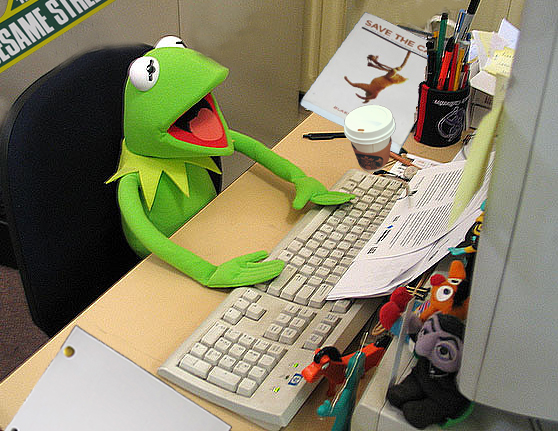
An experienced reader can – and will – pick up your script and be able tell in one to two minutes tops if you’re an accomplished writer or an aspiring amateur. One of my earliest ScriptMag articles, It’s Not Easy Being Green, shows you how to convince us you’re inexperienced, brought to you straight from Sesame Street!
Any of these rewriting techniques can elevate your writing, which is essential in impressing readers with your execution.
All of them are designed to trick your brain into seeing your words on the page with fresh eyes.
While a great consultant can catch these fumbles, practicing them with these rewriting strategies will train your brain to become aware of them as you write. Strengthening these muscles one at a time makes the heavy lifting easier with each script and every draft you do, as it becomes instinct instead of effort.